
Volumetric flow meter: how it works, main types and solutions
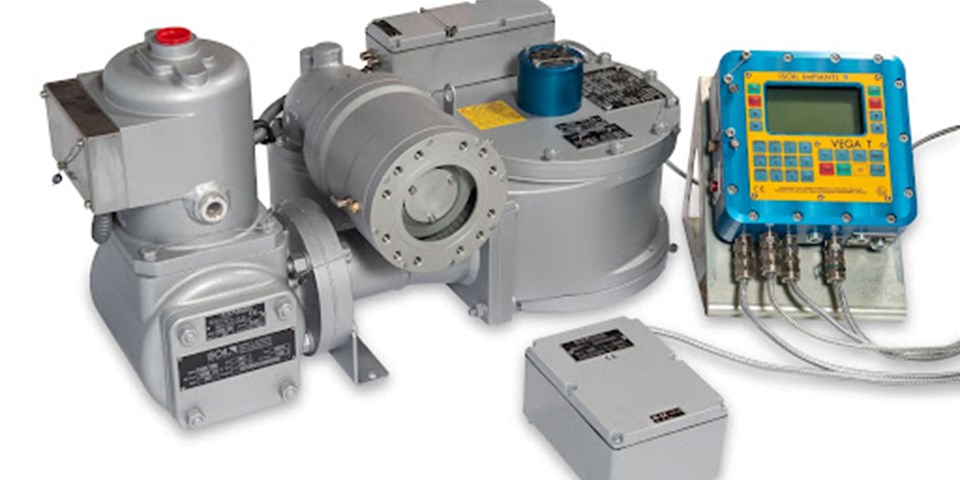
What is a volumetric flow meter and how does it work? Why is it so important for fluid measurement in the oil industry?
Flowrate is one of the essential parameters measured in process industries such as oil and gas. For example, in truck loading and unloading processes, the volume of fuel has to be controlled and measured in compliance with national and international laws.
What is a volumetric flow meter?
A volumetric meter is a flowrate measuring device used to determine a liquid's linear volumetric flow. They aim to improve accuracy, and resolution of fluid measurement.
They result in a great investment to improve efficiency, have low maintenance, are easy to use, versatile and durable. ISOIL offers Positive Displacement meters (PD meters), a type of volumetric flow meter that requires the fluid to mechanically displace components inside the meter for flow measurement.
Are you in need of a volumetric flow meter or just want more information?
How does a flow meter work?
Volumetric flow meters are the only flow-measuring technology to directly measure the volume of fluid that passes through the flow meter itself. By flowing from the manifold to the body of the meter, fluid fills a high-precision chamber and makes the rotor inside it rotate. Since the amount of fluid that can be contained in this chamber is a known volume of fluid, the volume passing through the meter can be calculated by multiplying the number of rotations by the measuring chamber volume.
Mechanical positive displacement meters rely on rotation to drive a magnetic coupling or a direct gear train connected to the mechanical counter. If paired with a pulse emitter mounted on the front cover, the meter can also be connected to an electronic counter.
PD flow meters do not require a power supply for their operation and they do not require straight upstream and downstream pipe runs.
Volumetric flow meter types and working principle
Volumetric flow meters are very accurate and have high turndown. They require no straight pipe runs for fluid flow stream and they are not sensitive to vibrations nor to the flow profile.
ISOIL PD meters are divided into categories according to the materials of the body, their construction, and their working principle.
Stainless steel volumetric flow meters (2’’ – 6’’)

This volumetric flow meter is made of stainless steel 316, for greater resistance. It is available for different applications: chemical, petrochemical, food industry, etc….
| Type | Flange | Flow rate | |
| SBMX 75 | 2” | 50 – 500 l/min | Manual |
| BMX 200 | 3” | 120 – 1300 l/min | Manual |
| BMX 200 | 3” | 120 – 1300 l/min | Manual |
| BMX 400 | 4” | 200 – 2400 l/min | Manual |
| BMX 600 | 6” | 300 – 3400 l/min | Manual |
Discover the meter
Single Case volumetric flow meters (1 ½’’ – 8’’)

Single case volumetric flow meters are the broadest range of ISOIL solutions for measurement. They can be made of different materials, such as aluminum or carbon steel depending on the size and use. They can be installed horizontally or vertically.
Double Case volumetric flow meters (3’’ – 10’’)

The double case design allows this volumetric flow meter to be immune to pressure variations, making it more reliable and accurate. Double case pd meters are composed of an outer body that surrounds the internal one (the measuring chamber) and bares the entire pressure difference between the liquid pressure and the external pressure.
Gravity flow meters (3’’ – 4’’)

Gravity volumetric flow meters are used when there is no pump, and the liquid flows by gravity. They ensure a very small pressure difference, to work under a limited inlet pressure and can handle the presence of air which is usually present in the fluid during unloading operations.
Pump & Gravity flow meters (3’’ – 4’’)

Do you need more flexibility? A pump & Gravity flow meter is the right solution. It has a very small pressure drop and is capable of operating under a limited inlet pressure when the delivery is taken by gravity or pump. It can also work in combination with a pump to handle the presence of the air slugs which is usually present in the fluid during unloading operations.
Application sectors of volumetric flow meters
Volumetric flow meters are widely used in industries where high accuracy, repeatability, and reliability are required, especially when measuring liquids under variable operating conditions.
- Oil & Gas: used for custody transfer, truck loading and unloading, refineries, terminals, and fuel distribution systems where precise volumetric measurement is required by national and international regulations.
- Chemical & Petrochemical Industry: used for the measurement of aggressive, corrosive, or hazardous liquids such as chemicals, solvents, and additives, thanks to robust materials like stainless steel.
- Fuel distribution & terminals: used in loading racks, depots, and tank farms to ensure accurate volume measurement for billing, inventory control, and regulatory compliance.
- Marine & Bunkering: used during marine fuel bunkering operations, as well as with high-viscosity fuels, due to their high accuracy, reliability, and resistance to pressure variations.
- Industrial process plants: used wherever continuous and precise volumetric flow measurement is required, even in the presence of flow disturbances or variable viscosity.
Calibration and verification of volumetric flow meters
To ensure long-term accuracy and compliance with metrological requirements, volumetric flow meters should be periodically verified and calibrated.
Calibration is typically performed using master meters, which are reference flow meters with certified accuracy, installed in series with the meter under test. By comparing the measured volume with the master meter, it is possible to verify performance, detect deviations, and apply correction factors as needed.
ISOIL supplies dedicated master meters and proving tanks designed specifically for the calibration and verification of volumetric flow meters, both in field and test bench applications. These solutions ensure high repeatability, traceability, and compliance with international standards, making them ideal for custody transfer and regulated environments.
The use of ISOIL master meters allows customers to maintain measurement accuracy over time while minimizing downtime and operational costs.
The advantages of choosing ISOIL
For decades in the industry, ISOIL has had undoubted advantages over its competitors, first of all, the accuracy of its measuring instruments, calibrated according to more stringent parameters than those required. In addition, relying ISOIL portrait relies on:
- Support - ISOIL follows the entire process at 360°, even after installation ensures all the assistance necessary to grant efficiency and safety for customers.
- Custom Tailor-Made solutions - ISOIL stands out for its ability to customize products based on the Customers’ specific requests, even when they differ from standard.
Discover more about our volumetric flow meters
Frequently Asked Questions (FAQ)
What is a volumetric flow meter?
A volumetric flow meter (positive displacement) measures the actual volume of liquid passing through the meter itself by mechanically trapping and counting fixed volumes of fluid.
How accurate is a volumetric flow meter?
Volumetric (positive displacement) flow meters are among the most accurate flow measurement technologies, often achieving accuracy better than ±0.2%, depending on the model and application.
What is the difference between volumetric and mass flow meters?
Volumetric flow meters measure volume, while mass flow meters measure mass flow rate. Volumetric meters are ideal when volume-based measurement is required for billing or custody transfer.
Do volumetric flow meters need power supply?
Mechanical PD volumetric flow meters do not require external power. Power is only needed if electronic counters or pulse transmitters are installed.
Can volumetric flow meters handle viscous fluids?
Yes. Volumetric flow meters are particularly suitable for high-viscosity liquids up to certain value.
Do volumetric flow meters require straight pipe runs?
No. One of their main advantages is that they do not require straight upstream or downstream pipe lengths and are not sensitive to flow profile disturbances.
Are volumetric flow meters suitable for custody transfer?
Yes. Due to their high accuracy, repeatability, and reliability, volumetric flow meters are widely used in custody transfer applications in oil & gas and fuel distribution.
How long does a volumetric flow meter last?
With proper installation, use, and regular maintenance, a volumetric flow meter can operate reliably for decades, even in demanding industrial environments.
Contact us for more information about our services and products

 Form sent successfully
 Error
Error