
ISOIL Earns ISO 14001 Certification: A Key Step Toward Sustainability
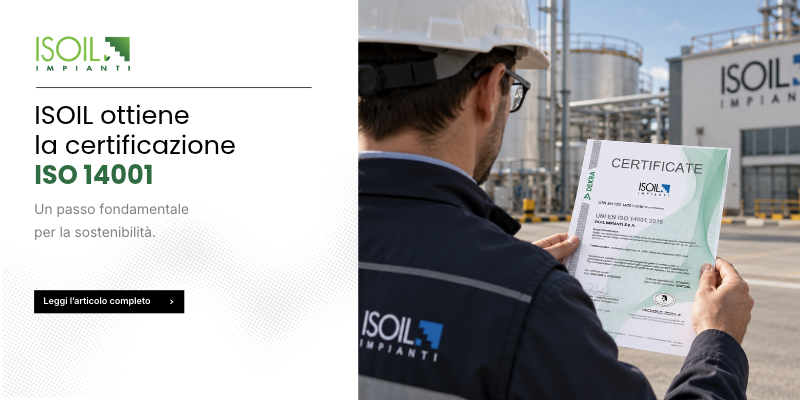
In February 2026, ISOIL Impianti earned ISO 14001 certification for its environmental management system, issued by DEKRA Testing and Certification. It marks the end of a journey of about a year that involved the entire organization, from management and the HSE department to production.
What ISO 14001 certification is and why it matters in the energy sector
UNI EN ISO 14001:2015 is the international standard that defines the requirements for an environmental management system. The name itself tells its story: published by ISO, adopted at the European level (EN), and implemented in Italy by UNI. It is a voluntary standard that applies to organizations of any industry and size.
The standard does not set the same performance limits for everyone. Instead, it requires a company to understand its environmental aspects (consumption, waste, substances used, potential emergencies), meet its compliance obligations, prevent pollution, and improve over time.
The method follows the Plan-Do-Check-Act cycle: plan, implement, check, and correct.
The certificate is issued by an accredited third-party body, which verifies on site that the system exists, is applied, and works. It is not a self-declaration: the certification has a defined validity period and is subject to periodic surveillance audits.
In the energy sector, this carries particular weight. ISOIL designs and manufactures positive displacement meters for liquids and automation systems for oil terminals: technologies that operate along the fuel logistics chain, an industry the market has long associated with a potentially high environmental impact. In this context, showing through a verifiable benchmark how a company manages its environmental aspects is a concrete way to separate the perception of the industry from the conduct of an individual business.
ISOIL's path to certification
The process took about a year and concluded with DEKRA Testing and Certification issuing the certificate on February 26, 2026. ISOIL approached it not as a box to check, but as an opportunity to examine how the company works every day, identify room for improvement, and develop a clearer understanding of the environmental impact of its activities.
The work involved several functions, each with a specific role:
- HSE department: coordinated and structured the system, overseeing environmental management and compliance.
- Management: provided the resources, time, and tools to turn environmental goals into concrete actions.
- Production: contributed by paying closer attention to how materials, substances, and waste are handled.
- Offices: changed some habits, with more attention to consumption and waste sorting.
A key milestone was the internal audits, carried out with the support of external consultants. The audits served to check the effectiveness of existing procedures, but above all to look at the company from a different perspective and challenge some long-established ways of working. The guiding question was not just "Are we following the rules?" but "Can we do better?"
From theory, the company moved to practice. The work focused on three areas: waste management, engaging the supply chain, and monitoring consumption and resources.
- Waste management and sorting. Waste sorting is not new at ISOIL: for several years, the company has had dedicated bins for different types of waste, which are then disposed of separately. With the environmental management system, this habit has become part of a structured process: waste handling, storage, and transport have been made more orderly and controlled, with greater attention to correctly identifying and separating materials. Every material has its own path, but the system only works if everyone, at their own workstation, knows how to recognize it and follow it.
- ESG supplier assessment. A company's environmental impact does not stop at its own doors: it also runs through the partners that help make its products. That is why ISOIL has introduced an ESG assessment of its suppliers, based on a questionnaire covering environmental, social, and governance topics. More than a selection tool, the questionnaire is a starting point: it helps ISOIL better understand how each partner approaches these issues and opens a dialogue that, over time, extends the same attention across the entire supply chain.
- Monitoring consumption and resources. For a company whose business is measurement, this third area comes naturally. ISOIL has started structured monitoring of water use and fuel consumption by company vehicles, the use of raw materials and chemicals, and waste generation and management.
Collecting this data makes visible what usually is not: understanding how the company uses its resources, spotting any anomalies, and assessing over time where to act to improve efficiency.
What activities the certification covers
Every ISO 14001 certification specifies exactly which activities it applies to. For ISOIL Impianti, these are:
- design, manufacture, and servicing of positive displacement meters for liquids, with related accessories and mechanical and electronic devices;
- design, development, and servicing of automation software for oil terminals.
In other words, the environmental management system covers the entire life cycle of ISOIL's solutions, both meters and software: from design to manufacturing, all the way to maintenance and support.
What it means in practice for customers and partners
For companies that choose ISOIL as a supplier, the certification translates into three concrete benefits.
Fewer unknowns in the supply chain. A supplier that manages waste, substances, and consumption in a structured way, extends the same attention across its own supply chain, and is verified by a third party reduces the environmental risks a company inherits from its suppliers.
Easier supplier qualification and tenders. When ISO 14001 is among the qualification or tender requirements, the certificate is an immediate, verifiable reference that eliminates the need to document an environmental management approach case by case.
Alignment with partners' sustainability goals. For operators of fuel depots, terminals, and airports that have set their own environmental targets, certified environmental management makes ISOIL a partner aligned with those goals, in a market increasingly shifting toward biofuels and sustainable fuels.
From certification to continuous improvement
Earning the certification was an important milestone. For ISOIL, however, the most interesting part starts now: maintaining it means digging deeper, year after year, into how the company works.
The monitoring launched with the environmental management system is still in its early stages: the data collected over these months describes the starting point. Starting next year, it will be possible to compare it with data from later periods and, on that basis, set measurable improvement targets tailored to the nature of ISOIL's activities. Periodic audits by the certification body will support this work throughout the certificate's validity, through February 2029.
The certification is also an opportunity to share more about a commitment that ISOIL had so far discussed mainly with its customers and suppliers. In upcoming articles, the story will continue with the everyday practices that make environmental management tangible inside the company, and with ISOIL's role in measuring lower-impact fuels, from biofuels to synthetic fuels.
Contact us for further information about our products and services

 Form sent successfully
 Error